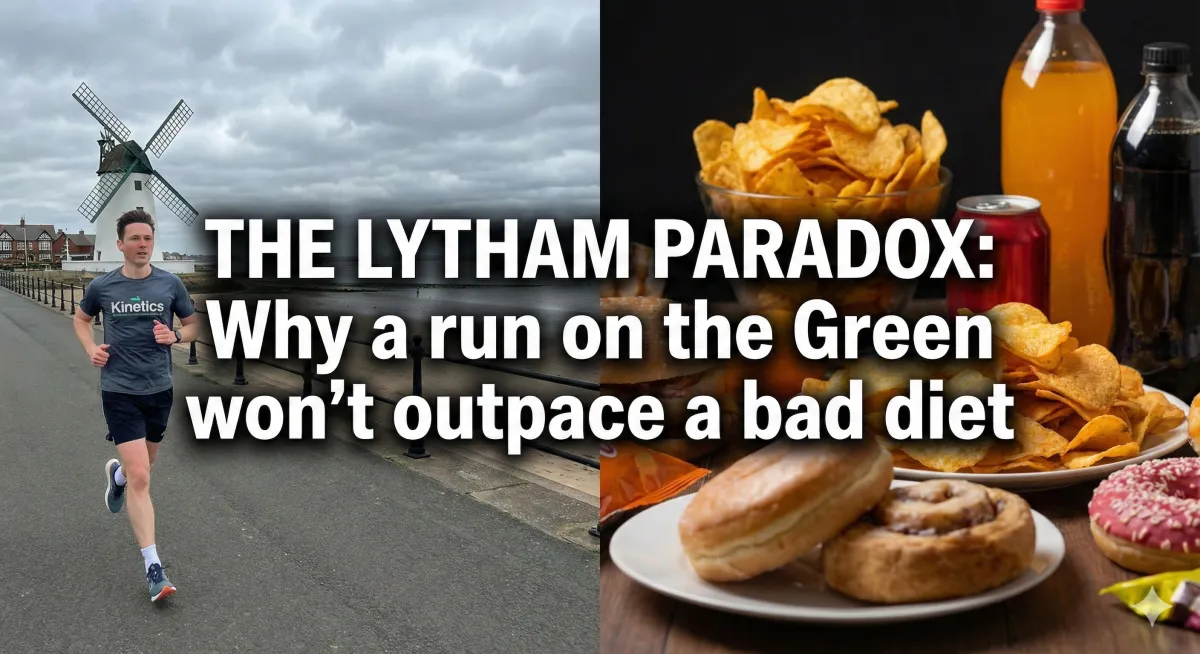
The Lytham Paradox: Why a Run on the Promenade Won't Outpace a Bad Diet
If you live here in Lytham St Annes, you know we are an active bunch. You see it every day: people power-walking along the Green, cycling down the coast road, or battling the bracing North West winds on a jog past the windmill.
We put in the effort. We try to move. So why does losing weight still feel like pushing a boulder uphill?
I’m about to tell you something that sounds completely backward, something that might make you want to throw your running shoes into the Ribble Estuary.

A Hadza hunter-gatherer in Tanzania—someone who walks 10+ miles a day tracking game and building shelter by hand—burns roughly the same number of daily calories as the average person sitting at a desk in Preston, driving home, and spending the evening watching Netflix.
It sounds insane. But massive new research has completely upended what we’ve been taught about exercise, metabolism, and weight loss.
If you’ve been beating yourself up for not "moving enough" to hit your goals, you need to read this.
The Study That Changes Everything
Researchers from Duke University recently completed one of the most comprehensive metabolism studies in history. They analysed data from over 4,200 adults across 34 different populations globally—from forager-farmers in Bolivia to office workers in industrialized cities.¹
They used "doubly labeled water," the gold standard for measuring exact calorie burn.
The old assumption was simple: "Calories in, calories out." We assumed people in developed nations move less than people in traditional societies, burn fewer calories, and therefore gain weight.
That assumption was wrong.
When researchers adjusted for body size, they found that people in industrialized nations burn essentially the same amount of daily energy as people living highly active, traditional lifestyles.
Yet, obesity is prevalent here in the UK and rare in traditional populations. The study’s conclusion is stark: dietary changes, not a lack of movement, account for more than 90% of the obesity crisis.⁵
Your Body’s "Metabolic Thermostat"
Here is the mind-bending part for anyone who hits the gym regularly: your body regulates your total daily calorie burn within a surprisingly narrow range, no matter how much you exercise.
Think of your metabolism like a household budget. You assume that if you work more hours, you earn more money. But what if your boss automatically adjusted your hourly rate down whenever you worked overtime to keep your total paycheck exactly the same?
That is essentially what your brain does with calories.³
When you start burning extra calories through a tough session at Kinetics, your brain notices. It starts making cuts elsewhere in the background—dialing down energy spent on inflammation management, cell repair, or other biological processes you don't notice.
This explains the frustration of working out religiously but seeing the scale refuse to budge.
The Lytham Food Environment vs. Biology
So, if it’s not the "calories out" problem, it’s a "calories in" problem.
Here in the Northwest, like everywhere else in the modern world, our food environment has undergone dramatic changes. We aren't fighting laziness; we are fighting ultra-processed foods.
These foods, which fill the middle aisles of our local supermarkets and corner shops, are precision-engineered by food scientists. They are hyper-palatable, calorie-dense, and terrible at making you feel full.⁴ They override your body’s natural "stop eating" signals.
Think about it: You could eat 1,000 calories of grilled chicken and roasted vegetables and feel stuffed for hours. Or you could eat 1,000 calories of processed snacks while watching TV and feel like you just had a light appetizer.
So, Why Bother Exercising at Kinetics?
Before you cancel your membership, let me be crystal clear: This science does NOT say exercise is unimportant.
The researchers emphasized repeatedly that exercise is absolutely essential for your heart health, mental resilience (vital during our dark winters), bone density, muscle maintenance, and reducing the risk of almost every chronic disease.⁶
We want you at Kinetics because movement makes you stronger, helps you sleep better, and improves your quality of life. Exercise is for health. Diet is for weight.
The Bottom Line for Our Community
For decades, we’ve been told that carrying extra weight is just about not moving enough. This science shows that it’s unfair. You are fighting biology that evolved to prevent starvation, pitted against a modern food industry designed to make you overconsume.
The good news? This is empowering. You don’t need to spend three hours a day training like an athlete to manage your weight (just 45 minutes 3 x a week @ Kinetics).
You need to shift your focus to what goes on your plate.
1. Stop trying to "earn" food with exercise. The maths doesn't work. (It takes about an hour of brisk walking on the prom just to burn off one glazed donut).⁵
2. Focus on whole foods. Lean proteins, vegetables, fruits, and healthy fats that actually satisfy hunger.
3. Move because it feels good. Come to the gym to build strength and improve your mood, not as punishment for what you ate yesterday.
At Kinetics, we’re here to help you get strong and healthy. But the real game-changer happens in your kitchen. Let’s start focusing on the right tools for the job.
Ask me or Joanne to add you to one of the Nutrition programmes to help you focus on Food intake whilst you still train 2 or 3 sessions a week.
Footnotes & References Based on Recent Research (Pontzer et al., PNAS):
¹ Energy expenditure data showed no significant differences in size-adjusted daily energy expenditure between traditional and industrialized lifestyles.
³ The "constrained total energy expenditure model" proposes the brain regulates total calorie burn by adjusting non-exercise energy expenditure.
⁴ Populations with higher ultra-processed food consumption showed greater body fat percentages independent of activity level.
⁵ Researchers concluded diet changes account for over 90% of obesity in developed countries.
⁶ Physical activity remains essential for cardiovascular health, mental health, and disease prevention despite minimal impact on weight loss.

Kinetics Gym and Personal Training
32-36 North Promenade, Lytham St Annes Lancashire FY8 2NQ